



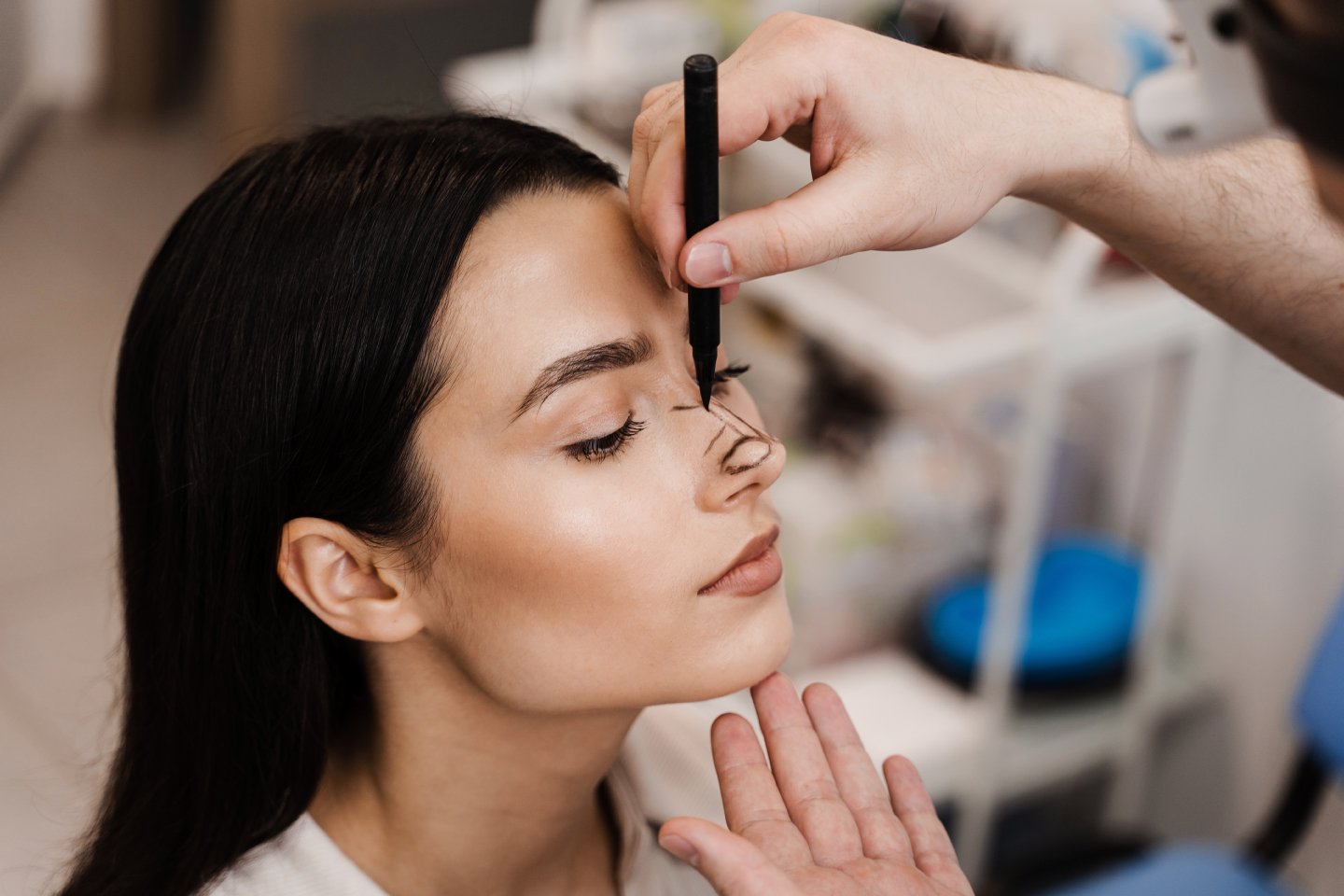
At Lam Facial Plastics in the Willow Bend Wellness Center near Dallas, Dr. Sam Lam has extensive experience with both primary and revision rhinoplasty. His dual board certification in otolaryngology-head and neck surgery and facial plastic surgery gives him a perspective that considers the nose as both an important facial feature and a major respiratory organ.
When Is Revision Rhinoplasty Actually Necessary?
Not every imperfection after rhinoplasty requires another operation. Revision becomes more reasonable when a meaningful problem persists after healing, such as:
- Unnatural nasal contour
- Inadequate correction of the original concern
- New asymmetry
- Excessive reduction
- Loss of structural support
- Impaired breathing
Dr. Lam is particularly cautious about noses that were treated too aggressively during the first surgery. A nose can initially seem acceptable after excessive cartilage removal but gradually lose support and begin to collapse over time. His meticulous approach emphasizes preserving or rebuilding nasal architecture rather than simply removing more tissue.
Revision Rhinoplasty Is About Structure, Not Just Appearance
A second rhinoplasty can be considerably more complicated than the first because the anatomy has already been altered. Scar tissue might be present, normal tissue planes may no longer be intact, and cartilage that would ordinarily be available for reshaping could already have been removed. In some revision cases, additional cartilage is needed to restore support.
This is one reason Dr. Lam generally favors an open rhinoplasty approach. The small incision between the nostrils lets him directly access the nasal framework and precisely secure structural cartilage grafts rather than working through a limited or “blind” pocket.
Correcting the Signs of an Unnatural Rhinoplasty
There are several signs that a primary rhinoplasty was performed inadequately, including:
- An overly scooped bridge
- A pinched or collapsed tip
- An excessively rotated tip
- Loss of the natural nasal sill where the nostril meets the upper lip
Revision surgery is considered when these changes significantly affect facial harmony. The goal, however, is not simply to reverse the first operation. Dr. Lam evaluates how the bridge, tip, and nostrils relate to one another so that correcting one area does not create a new imbalance elsewhere.
Gender Matters in Revision Rhinoplasty
Male revision rhinoplasty requires particular restraint. A man’s nose generally should retain a strong profile and a tip appropriate for a masculine face. If the original rhinoplasty over-reduced the bridge or excessively refined the tip using techniques better suited to a female aesthetic, revision surgery may focus on restoring stronger proportions rather than making the nose smaller.
Ethnicity Also Changes the Revision Strategy
Revision rhinoplasty cannot be planned according to one universal ideal. Dr. Lam avoids over-narrowing an African American nose, excessively raising an Asian nasal bridge, or overly reducing a Middle Eastern bridge. Thick skin can also affect how aggressively the underlying cartilage should be altered because too much cartilage reduction may encourage scar tissue and actually make the tip appear larger.
Timing a Second Rhinoplasty
Unless there is a significant functional or structural problem requiring earlier attention, revision rhinoplasty is generally considered only after the nose has had sufficient time to heal and stabilize. Operating again too early can make it difficult to distinguish temporary postoperative changes from problems that truly require correction.
Schedule a Revision Rhinoplasty Consultation in Dallas
A previously operated-on nose requires a personalized evaluation rather than a formulaic second procedure. To determine whether another surgery is appropriate and what can realistically be improved, schedule a revision rhinoplasty consultation with Dr. Sam Lam at Lam Facial Plastics in Dallas, Texas.
